



The global economy continues to expand despite ongoing conflict, rising energy prices, and mounting government debt. However, the International Monetary Fund (IMF) warned in its October 2026 World Economic Outlook that this resilience is becoming increasingly fragile. While substantial investment in artificial intelligence is helping offset some of the economic pressure, a worsening energy crisis or disappointing returns from AI investments could threaten the sustainability of global growth.
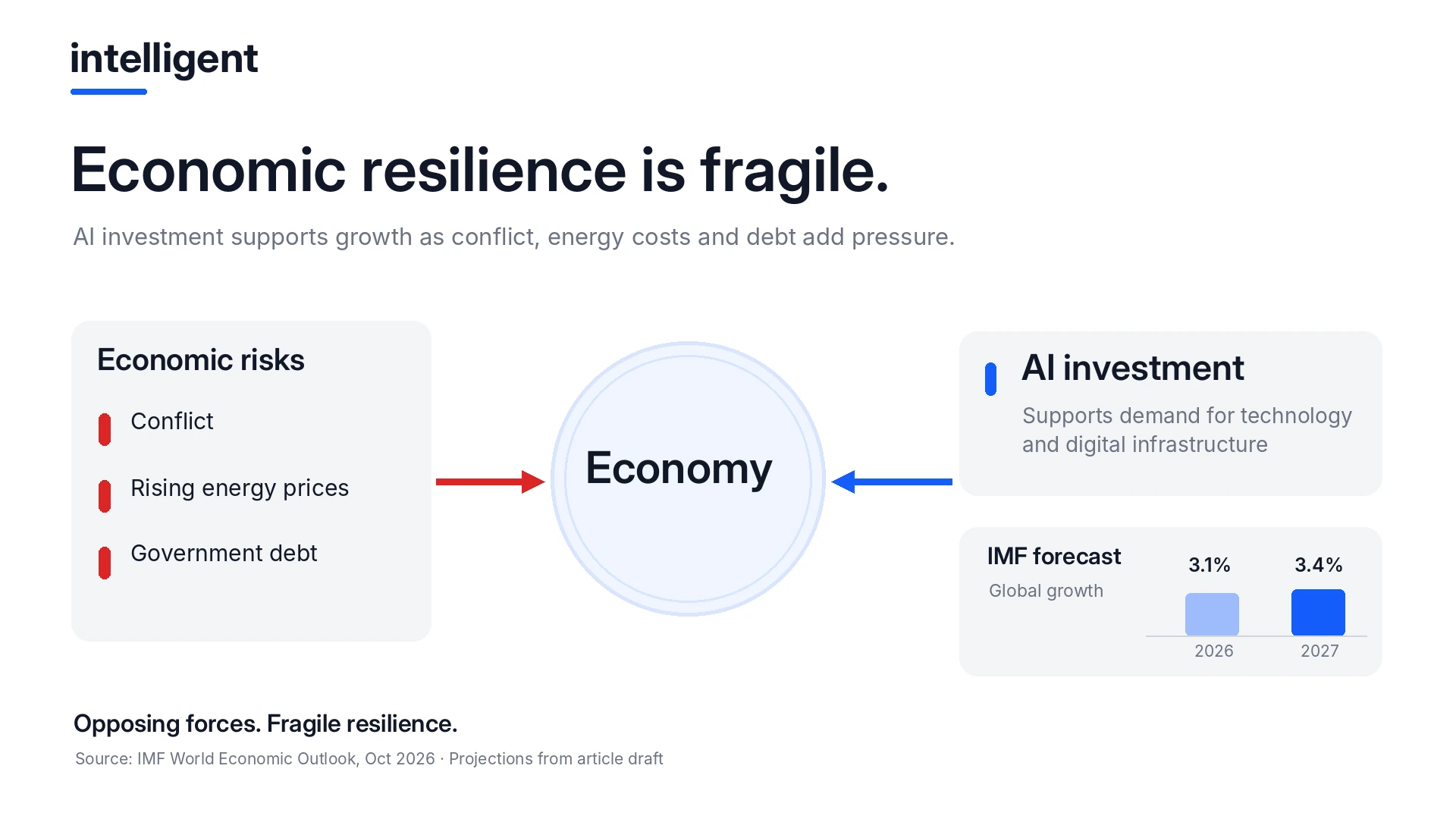
The global economy in 2026 is being shaped by two opposing forces. On one side, conflict in the Middle East and higher oil prices are increasing production and trade costs, adding to inflationary pressures. On the other, significant investment in artificial intelligence, data centers, and advanced technology infrastructure is supporting economic activity.
In its October 2026 World Economic Outlook, the IMF projected global economic growth of 3.1% in 2026, rising to 3.4% in 2027. However, the organization emphasized that risks to the outlook remain tilted to the downside.
This raises an important question: What is keeping the global economy growing despite these challenges, and how long can this resilience last?
Why Is the Global Economy Still Growing Despite the War?
During its October 13, 2026 press briefing, the IMF explained that the current economic outlook reflects the combined effects of two opposing forces.
The first is the increase in energy and commodity prices triggered by the war. This acts as a negative global supply shock, raising production costs, pushing prices higher, and restricting economic activity.
For example, rising oil prices increase transportation costs and make industrial production and food distribution more expensive. Businesses face higher operating expenses, while households experience declining purchasing power.
The second force is the artificial intelligence boom, which acts as a positive demand shock. Companies are increasing investment in technology infrastructure, creating stronger demand for equipment, services, and advanced computing capabilities.
This investment supports production, international trade, and economic activity, partially offsetting the negative effects of higher energy prices.
However, both forces can contribute to inflation. Higher energy prices increase production costs, while the AI boom can push prices higher through stronger demand. As a result, AI-driven economic growth does not necessarily mean that inflationary pressures will ease.
How Has Artificial Intelligence Become a Major Driver of Global Growth?
The economic impact of artificial intelligence is no longer limited to rising technology stock valuations. Investment in AI is increasingly influencing industries beyond the technology sector.
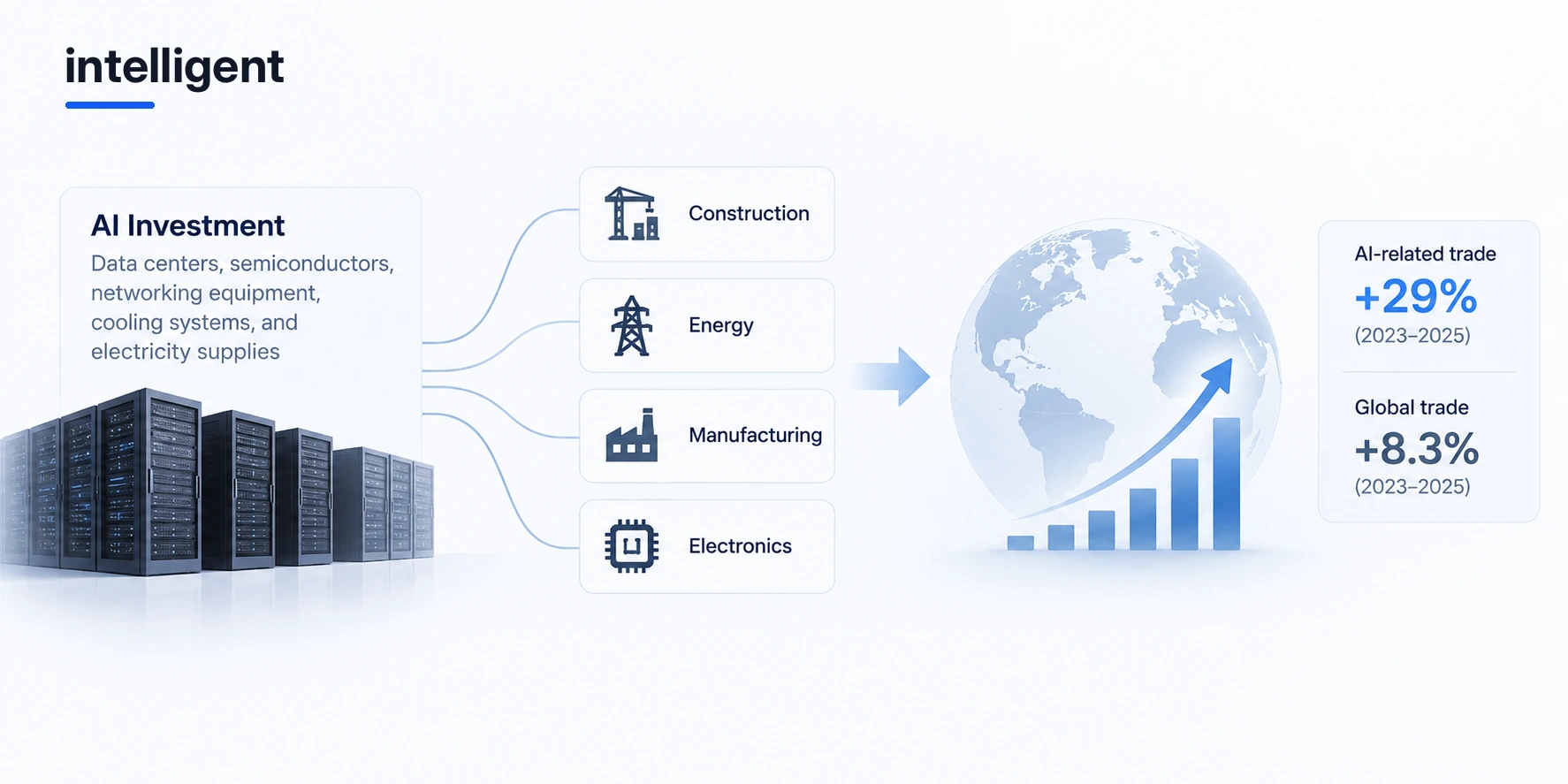
Developing advanced AI systems requires substantial physical infrastructure, including data centers, high-performance semiconductors, networking equipment, cooling systems, and reliable electricity supplies. Building these facilities creates demand across multiple industries.
For example, constructing a large data center requires more than purchasing servers and processors. It also involves construction services, electrical infrastructure, cooling equipment, and specialized technical expertise. Consequently, AI investment can support economic activity in construction, energy, manufacturing, and electronics.
According to Reuters, trade in AI-related goods increased by approximately 29% between 2023 and 2025, compared with an 8.3% increase in overall global trade during the same period. This difference illustrates how rapidly AI-related supply chains have expanded relative to international trade as a whole.
However, investment growth alone does not guarantee long-term economic benefits. For this expansion to remain sustainable, companies must eventually demonstrate that AI can generate meaningful revenue, improve productivity, and deliver adequate returns on invested capital.
This distinction between infrastructure investment and realized economic benefits is central to understanding the risks surrounding the current AI boom.
Why Does the IMF Consider Global Economic Growth Increasingly Fragile?
One of the IMF’s major concerns is that global economic growth is becoming increasingly concentrated in a limited number of countries and industries.
According to Reuters, the IMF’s latest estimates indicate that just 32 countries account for approximately 95% of global economic growth, compared with 54 countries in its April assessment. This suggests that although the global economy continues to expand, fewer economies are contributing substantially to that growth.
Countries participating in AI supply chains are benefiting from stronger demand for semiconductors, electronic components, and technology infrastructure. Meanwhile, some economies that depend heavily on imported energy but have limited exposure to AI-related industries face greater pressure from higher production and import costs.
South Korea, Malaysia, Mexico, and Thailand are among the economies that have benefited from growing demand for products and equipment associated with AI infrastructure.
However, the concentration of AI supply chains creates additional vulnerabilities. Advanced semiconductor manufacturing, critical technology components, and large-scale AI investment are concentrated among relatively few countries and companies.
Disruptions affecting these suppliers, or a reduction in investment by major technology firms, could therefore have consequences extending well beyond the technology sector. In this environment, artificial intelligence has become both a source of economic resilience and a potential source of systemic vulnerability.
What Would Happen if Oil Prices Reached $130 per Barrel?
Rising energy prices remain one of the most significant downside risks identified by the IMF.
In the baseline assumptions discussed in the October outlook, average oil prices are estimated at approximately $96 per barrel in 2026 and $87 per barrel in 2027.
However, the IMF has also examined a more adverse scenario involving a further escalation of the conflict and prolonged energy supply disruptions. If oil prices remain around $130 per barrel into the first quarter of 2027, global economic growth in 2027 could be approximately 0.5 percentage points below the baseline forecast.
Under the same scenario, global inflation in 2027 could increase by 1.1 percentage points, reaching approximately 5.2%. These outcomes would create two simultaneous challenges: weaker economic growth and higher inflation.
Such conditions make monetary policy decisions considerably more difficult. Central banks can generally support slowing economies by reducing interest rates, making borrowing and investment less expensive. However, when inflation remains elevated, lowering interest rates may intensify price pressures.
Keeping interest rates high, on the other hand, increases borrowing costs for businesses and governments and can discourage investment. This combination of weak growth and persistent inflation raises the risk of stagflation.
Consequently, developments in energy markets are important not only for oil producers and consumers but also for global monetary policy, bond markets, and financial stability.
What If the AI Investment Boom Begins to Slow?
Alongside the risks associated with energy prices, the IMF has warned about the possibility of a significant correction in AI-related investment.
Major technology companies have committed substantial financial resources to expanding data centers, purchasing advanced processors, and developing computing infrastructure. These investments are largely based on expectations that AI will generate higher future revenues and substantial productivity improvements.
However, if actual returns fall short of expectations, companies may reconsider their expansion plans, while investors may reassess the valuations of AI-related assets. A slowdown in investment could reduce demand for semiconductors, computing equipment, construction services, and other components of the AI supply chain.
In one adverse scenario examined by the IMF, a sharp reduction in AI investment, combined with declining asset prices and tighter financial conditions, could leave global economic output approximately 1.1% below its baseline path by 2028.
This does not represent a prediction of an inevitable global recession. Rather, it illustrates how changes in investor confidence and technology spending could affect the wider economy.
The more serious risk would emerge if a slowdown in AI investment occurred alongside another major increase in energy prices. Under those circumstances, the global economy could lose an important source of growth while continuing to face elevated inflation and production costs.
Why Is Government Debt Adding to Economic Risks?
The IMF has identified government debt as another important constraint on global economic resilience. When interest rates and government bond yields increase, countries face higher costs when issuing new debt or refinancing existing obligations.
For highly indebted governments, rising interest payments can consume a larger share of public budgets. This reduces the resources available for infrastructure development, essential public services, and financial support for vulnerable households.
For example, a government spending more on debt servicing may have less flexibility to introduce economic support measures during a future crisis. High borrowing costs can also limit public investment at a time when economies need to strengthen infrastructure, improve productivity, and respond to external shocks.
For these reasons, the IMF has recommended that countries with high debt levels and persistent fiscal deficits adopt credible plans to gradually improve their public finances.
The organization has also emphasized the importance of central bank independence, financial stability, and temporary, targeted support for vulnerable groups. The objective is to strengthen fiscal resilience without creating additional inflationary pressures.
Which Economic Indicators Should Investors and Businesses Monitor?
Understanding the direction of the global economy requires more than following headline growth figures. Several indicators can help investors and business leaders assess emerging risks and opportunities.
1. Oil prices and energy supply conditions
Sustained increases in oil prices can raise production and transportation costs, contributing to inflation. Supply disruptions and geopolitical developments are therefore important indicators of potential economic pressure.
2. Inflation and central bank interest rates
Inflation trends and monetary policy decisions influence corporate borrowing costs, bond yields, and asset valuations. Persistently high inflation may limit the ability of central banks to reduce interest rates.
3. Capital expenditure by major technology companies
Investment in data centers, semiconductors, and computing infrastructure can provide insight into whether the AI boom is continuing or beginning to slow.
4. Actual returns and productivity gains from AI
Revenue growth, operating cost reductions, and measurable productivity improvements are important indicators of whether large AI investments are generating sustainable economic value.
5. Government debt and bond yields
Rising borrowing costs can constrain public spending and reduce governments’ ability to respond to economic shocks.
Monitoring these indicators together can help businesses and investors better understand changing economic conditions rather than relying solely on short-term financial market movements.

Conclusion: How Long Can the Global Economy Remain Resilient?
The IMF’s October 2026 outlook suggests that the global economy continues to grow despite geopolitical conflict, higher energy prices, and mounting debt pressures. However, this resilience should not be mistaken for immunity to future economic shocks.
Investment in artificial intelligence has helped offset some of the negative effects of the energy crisis. Yet the concentration of AI supply chains among a limited number of countries and companies, together with uncertainty surrounding long-term investment returns, creates new vulnerabilities.
At the same time, persistently high oil prices and inflation could restrict central banks’ ability to lower interest rates, increasing financing costs for governments and businesses.
The future of global economic growth therefore depends not simply on continued technology investment or lower energy prices, but on the interaction between these forces.
The global economy has demonstrated resilience, but that resilience is not guaranteed to last. Energy prices and the actual economic returns generated by AI investment will be among the most important factors shaping global growth in the years ahead.
Sources
International Monetary Fund (IMF). World Economic Outlook: Resilience Under Strain, Urgent Choices. October 2026.
https://www.imf.org/en/Publications/WEO
International Monetary Fund (IMF). World Economic Outlook Press Briefing. October 13, 2026, Bangkok.
Reuters. AI Investment Props Up Global Growth, but War and Debt Threaten Outlook, IMF Says. October 13, 2026.
Reuters. IMF Flags Risks to Global Economy from AI Market Correction, War and Debt. October 13, 2026.