



How to Build an Aggressive, Diversified, and Well-Managed Investment Portfolio
Introduction
Achieving higher returns is one of the primary objectives of many investors. However, pursuing higher expected returns generally involves accepting greater levels of risk. In financial markets, assets with higher growth potential may also experience greater volatility and a higher probability of substantial losses.
A higher-risk, higher-return portfolio is designed to capture long-term capital growth opportunities. Under this approach, investors deliberately sacrifice a degree of short-term stability in exchange for the potential to achieve higher returns.
However, a professionally managed aggressive portfolio should not be confused with a collection of highly volatile assets or speculative investment decisions. As discussed in Building a High Risk, High Return Portfolio by Wright Research, evaluating potential returns without considering the associated risks does not provide a complete assessment of an investment opportunity.
In fact, risk management is no less important in an aggressive portfolio. Given the possibility of larger losses, such portfolios may require even more rigorous analysis and ongoing oversight.
This article examines the defining characteristics of a higher-risk, higher-return portfolio, the principles behind its construction and management, relevant macroeconomic factors, and real-world examples of investment portfolios with different risk profiles.
What Is a Higher-Risk, Higher-Return Portfolio?
An aggressive portfolio is a combination of financial assets designed primarily to achieve long-term capital appreciation while accepting greater volatility and potential losses than a conservative portfolio.
According to the Corporate Finance Institute (CFI), an aggressive investment strategy prioritizes capital appreciation over capital preservation or the generation of regular income.
In such portfolios, growth-oriented assets, particularly equities, typically receive a higher allocation, while fixed-income securities, cash, and other defensive assets represent a smaller proportion of total investments.
For example, a portfolio consisting of 80% equities and 20% fixed income will generally be more sensitive to equity-market movements than a portfolio containing 20% equities and 80% fixed income.
Nevertheless, portfolio risk is not determined solely by the allocation between equities and bonds. The types of assets held, investment concentration, correlations among holdings, and prevailing economic conditions also influence the overall risk profile.
Greater risk does not guarantee higher returns. Investors accept greater uncertainty in pursuit of potentially higher investment performance.
Defining Characteristics of a Professionally Managed Aggressive Portfolio
Emphasis on Long-Term Capital Growth
One of the defining characteristics of an aggressive portfolio is its emphasis on long-term capital appreciation. Under this approach, investors typically allocate a greater proportion of their capital to assets expected to offer stronger growth potential.
These investments may include growth stocks, technology and innovation companies, industries benefiting from long-term economic and technological megatrends, small-cap equities, and companies operating in emerging markets.
In its discussion of aggressive investment strategies, the Corporate Finance Institute identifies smaller companies and emerging markets as potential investment opportunities, while recognizing that these investments may involve greater economic, operational, and market risks.
However, a company's or industry's growth potential is not sufficient on its own to justify an investment. Financial strength, profitability, valuation, and the economic outlook must also be evaluated.
Greater Allocation to Higher-Growth Assets
Asset allocation is one of the most important determinants of a portfolio's risk and expected-return characteristics. Aggressive portfolios typically assign a larger proportion of capital to equities than to bonds and defensive assets. However, no single allocation is appropriate for every investor.
For example, Fidelity Investments provides model portfolios designed for different levels of risk tolerance:
These examples demonstrate how higher risk tolerance is often associated with increased equity exposure. Nevertheless, the objective of professional portfolio management should not simply be to maximize exposure to the riskiest assets. Capital should be allocated in a manner that considers the relationship between each investment’s potential return and its contribution to overall portfolio risk.
Alignment with Investment Horizon and Loss Capacity
A higher-risk portfolio is not suitable for every investor. One of the most important considerations in selecting an aggressive allocation is the investment horizon.
Investors who expect to need their capital in the near future have limited time to recover from adverse market movements. Conversely, investors with several years before their financial objectives must be achieved may have greater flexibility to withstand temporary market corrections and potentially benefit from long-term growth.
According to the U.S. Securities and Exchange Commission's (SEC) guidance on Asset Allocation and Diversification, an appropriate allocation should reflect both an investor's investment horizon and risk tolerance.
Beyond the investment horizon, the investor's financial and behavioral capacity to absorb losses is equally important. For example, an investor who responds to a sharp decline in portfolio value by immediately selling their holdings may struggle to maintain a long-term aggressive investment strategy.
Therefore, a higher-risk portfolio must align not only with investment objectives but also with the investor's actual ability to withstand substantial drawdowns.
Effective Diversification and Correlation Management
A common misconception about aggressive portfolios is that diversification becomes less important when investors deliberately accept higher risk. In reality, diversification remains a fundamental principle of portfolio risk management.
Consider an investor holding shares in ten different companies, all operating in the technology sector. If these companies are exposed to similar economic drivers, they may decline simultaneously during periods of rising interest rates or weakening expectations for economic growth. Although the portfolio contains multiple securities, its effective diversification may be limited.
As explained in the CFA Institute’s Portfolio Risk and Return, portfolio risk depends not only on the risk characteristics of individual assets but also on their portfolio weights and the correlations among their returns. Fidelity Investments also emphasizes the importance of distributing capital across asset classes and maintaining a diversified allocation over time in The Guide to Diversification.
- Sector diversification: avoiding excessive dependence on a single industry.
- Geographic diversification: distributing investment exposure across different markets.
- Company diversification: reducing reliance on the performance of individual companies.
- Economic-factor diversification: evaluating exposure to interest rates, economic growth, currencies, and other macroeconomic variables.
- Asset correlation: assessing the extent to which investment returns move together.
The objective of diversification is not to eliminate all investment risk but to reduce excessive dependence on a particular asset, industry, or economic factor.
Concentration Risk and Position Sizing
Concentration risk arises when a significant proportion of a portfolio is exposed to a single security, sector, or underlying risk factor. This issue is particularly important in aggressive portfolios because some growth-oriented investments may experience substantial price fluctuations.
Even shares of a financially strong company can increase overall portfolio risk if they represent an excessively large allocation. For example, if a substantial proportion of invested capital is concentrated in one company, a sharp decline in its share price could significantly affect the portfolio’s total return.
Consequently, security selection represents only one component of professional portfolio management. Position sizing, sector concentration, and the contribution of individual holdings to total portfolio risk must also be considered.
An aggressive portfolio may also allocate a limited proportion of its capital to highly volatile assets, such as certain cryptocurrencies or commodities. However, these investments require careful assessment of liquidity risk, regulatory risk, and the possibility of substantial losses.
A professionally managed aggressive portfolio should not sacrifice concentration controls in pursuit of higher potential returns.
Liquidity Management and Reduced Defensive Exposure
Aggressive portfolios generally maintain smaller allocations to cash and defensive assets than conservative portfolios. The intention is to increase the proportion of capital exposed to potential market growth.
However, reducing cash allocations does not eliminate the need for adequate liquidity. Liquidity refers to the ability to convert an investment into cash within an appropriate timeframe and without incurring substantial transaction costs or price concessions.
If an investor requires funds during a market downturn, they may be forced to sell investments under unfavorable conditions. Accordingly, even an aggressive portfolio should account for short-term financial needs, the marketability of its holdings, and the potential cost of exiting investment positions.
This consideration is also discussed in Fidelity’s Give Your Portfolio a Checkup, which highlights the importance of reviewing portfolio allocations in relation to financial circumstances, investment objectives, and time horizons.
Return Quality and Maximum Drawdown Assessment
One of the main differences between professional portfolio management and an investment approach focused exclusively on returns is the emphasis placed on the quality of investment performance.
When evaluating an aggressive portfolio, it is not enough to ask how much annual return the portfolio is expected to generate. It is equally important to determine how much risk the investor must accept to pursue that return.
Two portfolios may generate similar returns while exhibiting substantially different levels of volatility and drawdown throughout the investment period. Their risk-adjusted performance may therefore differ considerably.
Quantitative performance evaluation, including drawdown analysis and the Sharpe ratio, is also relevant to the assessment of aggressive investment strategies discussed by CFI. Importantly, none of these indicators can independently provide a definitive assessment of future losses. A more comprehensive evaluation requires multiple risk measures to be considered together.
Continuous Monitoring, Rebalancing, and Stress Testing
Portfolio allocations change over time as asset prices fluctuate. For example, if equities in a particular sector appreciate more rapidly than other investments, that sector’s portfolio weight will increase. This may cause the portfolio’s risk exposure to move beyond its initially established limits.
Rebalancing is the process of reviewing asset weights and adjusting them toward their intended targets when necessary. Vanguard’s portfolio management guidance identifies several approaches to rebalancing, including calendar-based rebalancing, threshold-based rebalancing, and combinations of the two.
In addition to rebalancing, stress testing can help identify potential vulnerabilities within an aggressive portfolio. For example, analysts may evaluate how a portfolio could respond to adverse scenarios such as a financial crisis, a sharp rise in interest rates, or a significant equity-market decline.
The objective is not to forecast future crises precisely but to identify risks that may be less apparent under normal market conditions.
Macroeconomic Factors Affecting Aggressive Portfolio Performance
Portfolios with higher allocations to equities and other growth-oriented assets may be particularly sensitive to changes in macroeconomic conditions. A comprehensive assessment of aggressive portfolio risk should therefore consider both individual holdings and the economic factors affecting the portfolio as a whole.
Different assets may respond similarly to economic shocks. For example, a sharp increase in interest rates can simultaneously place downward pressure on growth-stock valuations and the prices of certain fixed-income securities. Consequently, holding several asset classes does not necessarily provide complete protection against common economic risks.
How to Construct a Higher-Risk, Higher-Return Portfolio
Building an aggressive portfolio requires a structured and measurable investment process. Wright Research identifies several important elements in constructing a high-risk, high-return portfolio, including risk assessment, investment objectives, asset allocation, opportunity identification, investment research, risk management, and continuous monitoring.
Defining Investment Objectives and Constraints
The process begins by identifying the investor’s financial objectives, investment horizon, liquidity requirements, and ability to tolerate losses. These considerations establish the foundation for determining an appropriate portfolio risk profile.
Establishing Asset Allocation
Once the investment objectives are defined, capital is distributed across suitable asset classes. Aggressive portfolios generally place greater emphasis on equities and other growth-oriented investments.
Selecting and Evaluating Investments
Potential holdings should be evaluated based on financial quality, valuation, growth prospects, economic risks, and liquidity. Security selection should consider not only the attractiveness of individual investments but also their contribution to the broader portfolio.
Assessing Total Portfolio Risk
After selecting potential holdings, the portfolio should be evaluated for correlation, concentration, volatility, and potential drawdown. This stage helps determine whether the combined risk exposure remains consistent with the investor’s objectives and constraints.
Monitoring and Adjusting Portfolio Allocations
Portfolio performance and market conditions should be reviewed periodically. Where necessary, allocations may be adjusted to reflect changes in risk exposure, market conditions, or the investor’s circumstances.
This process demonstrates that professional aggressive investing involves more than selecting assets with high return potential. It requires structured planning, disciplined analysis, and ongoing risk management.
The Role of Artificial Intelligence and Quantitative Analysis in Aggressive Portfolio Management
Managing an aggressive portfolio may involve evaluating large numbers of investments, economic variables, and relationships among financial assets.
Quantitative tools and artificial intelligence can assist in processing financial data, analyzing correlations, identifying concentration risks, and evaluating alternative portfolio allocations. Quantitative models can also be used to assess potential portfolio outcomes under different market scenarios and compare expected returns with associated risks.
However, the reliability of these models depends on data quality, modeling assumptions, and prevailing economic conditions. For this reason, outputs from quantitative models and AI-based systems should not be treated as independent investment decisions. They should be reviewed alongside professional analysis and human oversight.
Real-World Case Study: Comparing an Aggressive 80/20 Portfolio with a Defensive 20/80 Portfolio
To illustrate how asset allocation can influence investment risk and performance, two established funds from Vanguard’s LifeStrategy range can be compared.
The Vanguard LifeStrategy 80/20 Fund (VASGX) has a target allocation of approximately 80% equities and 20% fixed-income securities. By comparison, the Vanguard LifeStrategy 20/80 Fund (VASIX) targets approximately 20% equities and 80% fixed-income securities.
Before May 12, 2026, these funds were known as the LifeStrategy Growth Fund and LifeStrategy Income Fund, respectively. The name changes were documented in official SEC filings and did not change the funds’ underlying investment policies.
Historical Performance Comparison
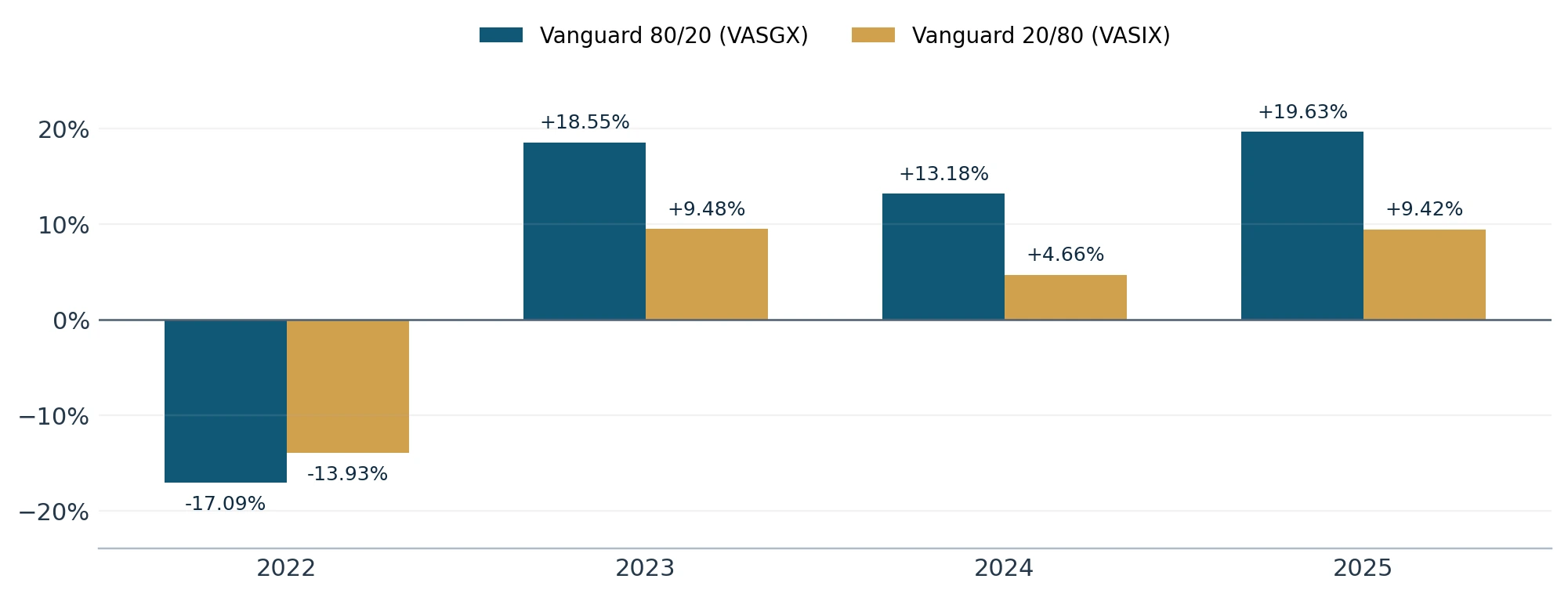
The following figures are drawn from official fund disclosures and documents filed with the SEC.
Performance Analysis
During the observed period, the fund with higher equity exposure generated stronger returns in 2023, 2024, and 2025. Its annualized return over the ten years ending December 31, 2025, was also higher than that of the more defensive fund.
However, both funds recorded negative returns in 2022, with the equity-heavy portfolio experiencing a larger loss. This comparison illustrates how increasing exposure to growth-oriented assets can lead to stronger performance during favorable market conditions while also producing greater losses during adverse periods.
Morningstar provides another relevant perspective in its article How Did the Bucket Portfolios Perform in 2025?, which examines the performance of illustrative aggressive, balanced, and conservative portfolios. In that analysis, the aggressive model portfolios delivered stronger returns than the balanced and conservative examples during 2025.
However, Morningstar’s model portfolios and Vanguard’s live investment funds represent different types of investment evidence and should not be treated as directly equivalent. These observations do not establish that an aggressive portfolio will consistently outperform a conservative portfolio.
Furthermore, a negative calendar-year return should not be confused with maximum drawdown, which measures the largest peak-to-trough decline over the observation period. A more comprehensive comparison of portfolio quality would require examining volatility, drawdowns, correlations, and other risk measures over consistent periods.
Which Investors May Be Better Suited to Aggressive Investing?
Higher-risk portfolios may be more appropriate for investors who prioritize long-term capital growth, have limited short-term liquidity requirements, and possess sufficient financial and behavioral capacity to withstand substantial fluctuations in investment value.
Conversely, aggressive portfolios may be unsuitable for investors who require capital preservation over a short horizon or who cannot tolerate significant losses. Selecting an appropriate level of risk requires consideration of several factors:
- Financial objectives
- Investment horizon
- Actual loss-bearing capacity
- Liquidity requirements and financial obligations
- Knowledge of financial markets and associated investment risks
Therefore, the desire to earn higher returns is not, by itself, a sufficient basis for adopting an aggressive investment strategy.
Managing Investment Costs in an Aggressive Portfolio
Investment costs represent another important consideration in portfolio management. Trading commissions, asset-management fees, taxes, and expenses associated with frequent portfolio adjustments can reduce investors’ realized returns.
These costs may be particularly relevant for portfolios employing active strategies or frequent trading. According to the SEC’s educational bulletin How Fees and Expenses Affect Your Investment Portfolio, even relatively small differences in investment expenses can have a substantial cumulative effect on portfolio value over time.
Consequently, investors evaluating aggressive strategies should consider investment returns after applicable costs, rather than focusing exclusively on gross performance.
The Difference Between Professional Aggressive Investing and Speculation
An aggressive portfolio should not be confused with purchasing a collection of volatile assets in the hope of achieving rapid price appreciation. Professional investment decisions should be based on analysis, clearly defined objectives, and measurable risk constraints.
Investors should understand which assets expose them to greater risk, why those exposures are being accepted, and how much potential loss may arise. Although both professional aggressive strategies and speculative investment approaches may involve volatile assets, the fundamental distinction lies in the quality of decision-making and the management of risk.
A professionally managed aggressive portfolio does not seek to maximize risk for its own sake. Instead, it aims to pursue an appropriate expected return in relation to the risks deliberately accepted.
Conclusion
A higher-risk, higher-return portfolio is an investment approach designed to increase long-term capital growth potential through the deliberate acceptance of greater volatility and possible losses.
Such portfolios generally maintain higher allocations to equities and growth-oriented assets, while defensive holdings account for a smaller proportion of total investments. However, pursuing higher potential returns without addressing diversification, concentration, liquidity, and potential drawdowns can expose the portfolio to substantial risks.
Professional aggressive portfolio management therefore requires appropriate asset allocation, analysis of economic risk factors, correlation management, quantitative risk assessment, and continuous monitoring.
Historical performance data from Vanguard’s LifeStrategy funds illustrate that portfolios with higher equity exposure can generate stronger returns in certain periods while experiencing greater losses in unfavorable market environments.
Ultimately, a successful aggressive portfolio is not simply the portfolio with the highest return. It is one in which the accepted risks are understood, remain consistent with the investor’s objectives, and are supported by a reasonable expectation of return.
References and Further Reading
Wright Research — Building a High Risk, High Return Portfolio: A Step by Step Guide — Akashdeep Bhateja; published October 2023, updated June 2024
https://www.wrightresearch.in/blog/building-a-high-risk-high-return-portfolio-a-step-by-step-guide/
Corporate Finance Institute — Aggressive Investment Strategy — CFI Team; published November 2020
https://corporatefinanceinstitute.com/resources/capital_markets/aggressive-investment-strategy/
Fidelity Investments — Fidelity Fund Portfolios — Illustrative portfolios including Aggressive Growth and Most Aggressive
https://www.fidelity.com/mutual-funds/fidelity-fund-portfolios/overview
U.S. SEC / Investor.gov — Asset Allocation and Diversification
https://www.investor.gov/introduction-investing/getting-started/asset-allocation
CFA Institute — Portfolio Risk and Return: Part I — CFA Program 2026 curriculum
https://www.cfainstitute.org/insights/professional-learning/refresher-readings/2026/portfolio-risk-return-part-1
Fidelity Investments — The Guide to Diversification
https://www.fidelity.com/viewpoints/investing-ideas/guide-to-diversification
Fidelity Investments — Give Your Portfolio a Checkup
https://www.fidelity.com/viewpoints/investing-ideas/portfolio-checkup
Vanguard — Rebalancing Your Portfolio: How to Rebalance
https://investor.vanguard.com/investor-resources-education/portfolio-management/rebalancing-your-portfolio
U.S. SEC — Vanguard LifeStrategy Growth Fund, Annual Total Returns
https://www.sec.gov/Archives/edgar/data/736054/000119312526077488/R64.htm
U.S. SEC — Vanguard LifeStrategy Income Fund, Annual Total Returns
https://www.sec.gov/Archives/edgar/data/736054/000119312526077488/R31.htm
Vanguard — LifeStrategy Growth Fund (VASGX), Summary Prospectus — Dated February 27, 2026
https://www.sec.gov/Archives/edgar/data/736054/000119312526077507/f44043d1.htm
Vanguard — LifeStrategy Income Fund (VASIX), Summary Prospectus — Dated February 27, 2026
https://www.sec.gov/Archives/edgar/data/736054/000119312526077512/f44042d1.htm
Vanguard — LifeStrategy Funds, Official Name Change Supplement — Effective May 12, 2026
https://www.sec.gov/Archives/edgar/data/736054/000073605426000102/f45201d1.htm
Morningstar — How Did the Bucket Portfolios Perform in 2025? — Christine Benz; published January 2026
https://www.morningstar.com/portfolios/how-did-bucket-portfolios-perform-2025
U.S. SEC / Investor.gov — How Fees and Expenses Affect Your Investment Portfolio
https://www.investor.gov/introduction-investing/general-resources/news-alerts/alerts-bulletins/investor-bulletins/updated