



From understanding market news and researching stocks to managing portfolio risk, discover how artificial intelligence can support more informed financial decisions.
Financial markets do not suffer from a shortage of information. The real challenge is knowing which information matters and how to use it.
Every day, investors encounter corporate earnings reports, economic data, analyst commentary, market forecasts, and opinions shared across social media. Some of this information is valuable. Other information may be outdated, incomplete, or misleading.
Imagine you are considering an investment in NVIDIA. You might want to understand how the company generates revenue, whether demand for AI infrastructure is sustainable, how its valuation compares with its risks, and what could happen if growth expectations change.
A simple online search can produce hundreds of answers. But it may not help you turn those answers into a reliable decision-making process. This is where artificial intelligence can help.
AI tools can summarize complex documents, explain financial concepts, organize company research, compare investment opportunities, and help investors examine different scenarios. However, there is an important distinction between using AI to support a financial decision and allowing AI to make that decision for you.
The smartest way to use AI in finance is not to ask it what to buy. It is to use AI to ask better questions.
In this article, we explore seven practical ways AI can support financial decision-making, with reusable prompts, a step-by-step stock research example, and the limitations every investor should understand.
Why AI Matters in Financial Decisions
Artificial intelligence is increasingly becoming part of the investment research process. CFA Institute examines how investment professionals use AI and machine learning for document analysis, investment screening, research, and extracting insights from large datasets.
Financial research involves three distinct stages: gathering information from statements, disclosures, and economic data; interpreting how those facts relate and what remains uncertain; and exercising judgment in light of personal objectives and risk capacity.
AI can support the first two stages and structure questions involved in the third. It cannot eliminate uncertainty or guarantee a successful financial outcome. The UK Financial Conduct Authority similarly explains that AI can simplify complex information while important facts still require verification.

1. Understand the Market
Financial markets constantly respond to new information. Central bank decisions, inflation reports, corporate earnings, geopolitical developments, and investor expectations can all influence asset prices.
Suppose a central bank announces that interest rates will remain higher for longer than expected. Some technology stocks may decline, bond yields may change, and currencies may react. AI can explain potential mechanisms: higher borrowing costs, changes in the present value of future earnings, and shifts in the relative attractiveness of assets.
AI can also distinguish an event from an interpretation. A company might report revenue growth while its share price falls because expectations were even higher, or investors are concerned about guidance or valuation. A useful AI request investigates possibilities without presenting speculation as fact.
Try This Prompt
Explain the most significant recent development affecting the technology sector. Separate confirmed facts from market interpretations. Identify original sources and dates, explain three possible implications, and describe what remains uncertain. Do not assume one event fully explains market price movements.
An AI model without live data may not know what happened today. Even with current sources, interpretation requires verification. The IMF has also noted that AI-driven trading may improve market efficiency while potentially amplifying volatility during stress.
Key takeaway: Use AI to understand developments and competing interpretations, not to turn every headline into a trading instruction.
2. Research Any Stock
Buying shares means accepting exposure to the performance and risks of a real business. Before investing, understand what the company does, how it earns money, and which factors could affect its future. “Is this stock a good buy?” is too broad to support careful research.
Understand the Business Model
Identify products, customers, and revenue drivers. For NVIDIA, this means understanding accelerated computing and AI infrastructure rather than relying only on AI-related headlines.
Examine Financial Performance
Investigate revenue, profitability, margins, cash flow, and balance-sheet strength. Rapid growth alone does not establish financial health or an attractive valuation.
Evaluate Competitive Advantages
Consider technology, customer relationships, market position, and competitors. Today’s advantage may not remain unchanged.
Identify Risks
Explore competition, demand shifts, regulations, supply constraints, and expectations already embedded in the share price.
Try This Prompt
Prepare a structured research brief for [COMPANY/TICKER] as of [DATE]. Explain the business model, revenue drivers, financial performance, cash flow, debt, valuation, competitive position, and principal risks. Use dated primary sources, distinguish facts from interpretations, identify missing information, and do not provide a buy or sell recommendation.
Investors should verify figures against earnings releases, annual and quarterly reports, and official regulatory filings. For US-listed companies, SEC EDGAR provides original company disclosures.
Making Financial Research More Conversational
Intelligent’s FinMate concept focuses on conversational financial research: asking questions, requesting explanations, and exploring investment topics through a connected research experience. Its development roadmap describes this direction; users should verify which capabilities are available before relying on them.
Key takeaway: AI can structure stock research, but it cannot replace accurate data, original documents, or independent judgment.
3. Compare Investments
Investors often compare opportunities attractive for different reasons: an individual technology stock versus a broad exchange-traded fund (ETF), or a growth asset versus an income-producing investment. The comparison should reflect personal goals, not just predicted returns.
An individual stock depends heavily on one company. A broad equity ETF may diversify across many companies, although its actual diversification depends on holdings and index methodology.
AI can explain trade-offs and identify missing information. A short-term government bond and a growth equity fund may serve entirely different financial purposes; ranking them solely by expected return ignores liquidity, time horizon, and risk.
Try This Prompt
Compare [INVESTMENT A] and [INVESTMENT B] for an investor with a [TIME HORIZON] and [FINANCIAL GOAL]. Evaluate diversification, liquidity, costs, risks, and sensitivity to economic conditions. Separate objective differences from personal suitability and identify data requiring verification.
AI should not invent current prices, fees, or historical returns. Sometimes the best conclusion is that more information is needed.
Key takeaway: Compare characteristics and trade-offs, not merely predicted performance.
4. Analyze Portfolio Risk
A portfolio can contain several securities yet remain concentrated. An investor might own large technology stocks, a technology ETF, and a broad market ETF. Some positions may overlap, and many may respond similarly to economic shocks.
An AI-assisted review can investigate concentration, overlapping fund holdings, geographic and currency exposure, liquidity, and the possibility of correlated losses during stress.
This is an example, not a suggested allocation. The portfolio may have substantial technology exposure even through its broad funds. Measuring actual overlap requires underlying holdings and weights.
Try This Prompt
Analyze this hypothetical portfolio: [PORTFOLIO]. Identify possible concentration, sector, geographic, currency, and liquidity risks. Explain where holdings may overlap, which data are needed for accurate measurement, and how different economic scenarios could affect the portfolio without predicting exact returns.
The CFA Institute Research Foundation’s Artificial Intelligence in Asset Management reviews AI applications in portfolio construction and risk modeling. Identifying risk, however, is not the same as eliminating it.
From Portfolio Analysis to Goal-Based Systems
Intelligent’s Robo Gen 2.0 describes a proposed goal-based, multi-agent approach to portfolio intelligence connecting research, portfolio construction, risk evaluation, and explanations within a governed methodology. It is a development direction, not evidence of currently available automated management or guaranteed risk reduction.
Key takeaway: What matters is not simply how many investments you hold, but which risks they share.
5. Plan Financial Goals
Investing for retirement in 25 years differs from saving for a home in three. Time horizon, liquidity requirements, and the consequences of losses affect which strategies may be suitable.
For education savings, the first questions are when the money is needed, how much it may cost, how much is already saved, what contributions are affordable, how inflation affects the target, and how much uncertainty the plan can tolerate.
AI can organize these inputs into a planning worksheet and create illustrative scenarios showing what changes if contributions fall or costs rise. Assumed returns should never be represented as guaranteed outcomes.
Try This Prompt
Build a financial planning worksheet for [GOAL] over [TIME HORIZON]. Include target amount, current savings, contributions, inflation assumptions, liquidity needs, and ability to tolerate losses. Identify missing information and develop three illustrative scenarios without recommending specific investments.
Goal-based planning also informs the proposed Robo Gen 2.0 methodology: starting with objectives, constraints, and risk rather than a ticker symbol.
Key takeaway: Goals provide the context required to evaluate investments.
6. Monitor What Matters
Markets generate more news than most investors can follow. Reacting to every headline can create confusion and unnecessary activity. A better process focuses on developments that could materially change the investment thesis.
For a company, monitor revisions to earnings guidance, changes in profitability, competitive threats, debt and cash flow, regulatory developments, and major management or strategic changes. For a portfolio, track allocation, concentration, liquidity needs, and changes in financial goals.
If a company revises guidance, compare the new statement with the previous one. What changed? How significant is the revision? Which assumptions are affected?
Try This Prompt
Compare the company’s latest official financial guidance with its previous guidance. Identify material changes, explain potential implications, separate facts from interpretation, and highlight developments that may justify reviewing the investment thesis.
The ability to analyze supplied documents is not the same as continuous market monitoring. Persistent watchlists and alerts require dedicated features and data connections; FinMate monitoring capabilities should be confirmed before being described as operational.
Key takeaway: Monitor what could change your reasoning, not every price movement.
7. Make Better Decisions by Exploring Different Scenarios
Investors naturally seek evidence supporting their existing beliefs. Someone enthusiastic about a company may focus on growth while overlooking valuation, competition, and financial risks. AI can help challenge those assumptions through scenario analysis.
Bull Case
What developments could produce a stronger-than-expected outcome? Possibilities include higher demand, better profitability, or successful expansion.
Base Case
What follows from a clearly defined set of central assumptions? A base case is a reference scenario, not necessarily the most likely future.
Bear Case
What could go wrong? Demand weakness, competition, higher costs, regulation, or an unfavorable valuation may challenge the thesis.
Try This Prompt
Develop bull, base, and bear scenarios for [COMPANY/TICKER]. Explain assumptions, uncertainties, and evidence that would weaken each case. Do not invent probabilities, target prices, or expected returns. Finish with the five most important unanswered questions.
Consider a hypothetical 20% investment decline. Would it disrupt a near-term goal? Would emergency savings remain sufficient? Would it reveal excessive concentration? Such questions are more useful than treating an AI-generated price forecast as a decision.
Key takeaway: Better decisions require contrary evidence, uncertainty awareness, and clear conditions for changing your mind.
Before You Buy NVIDIA, Ask AI These Questions
The seven applications can be combined into a single research workflow. “Should I buy NVIDIA?” is understandable but too broad: it does not establish a date, evidence requirements, valuation context, or personal objectives.
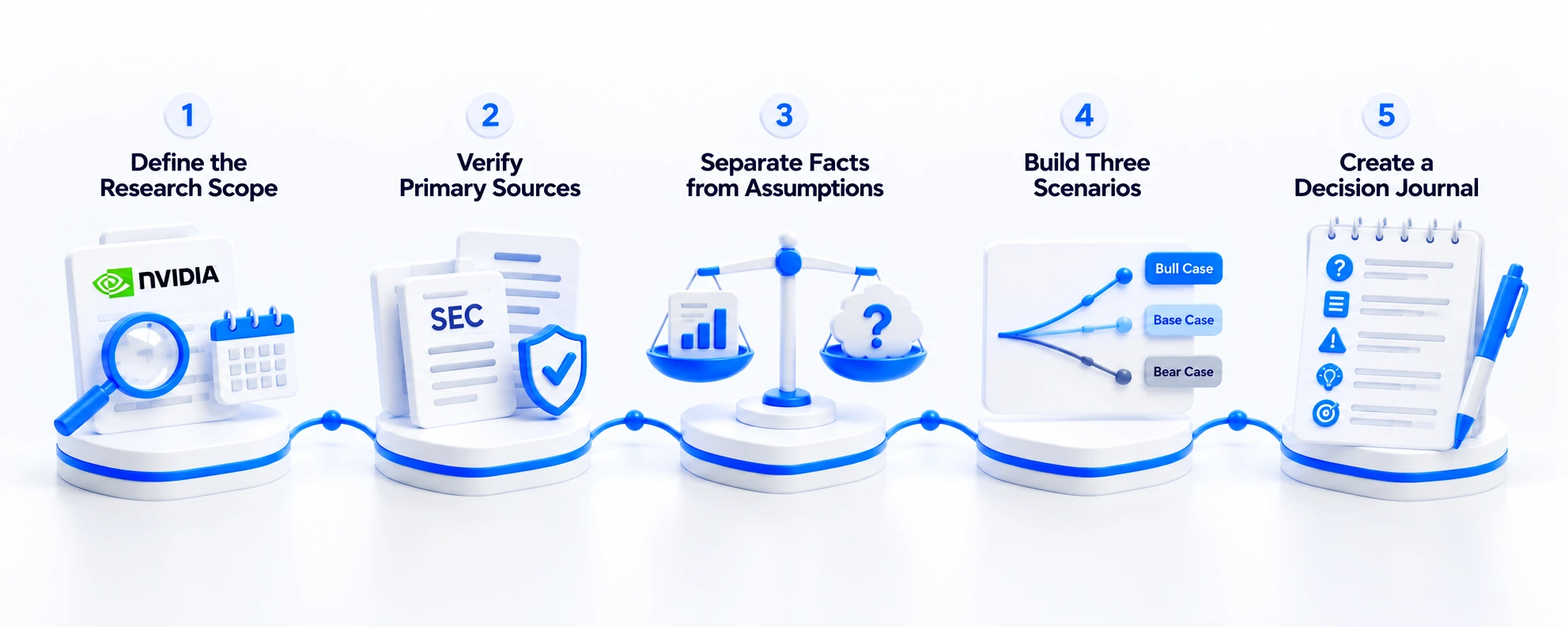
Step 1: Define the Research Scope
Specify the company, ticker, date, and required information. Ask AI to act as a research assistant rather than an investment adviser.
Comprehensive Stock Research Prompt
Prepare an evidence-based research brief for NVIDIA (NVDA) as of [DATE]. Use identifiable primary sources with links and dates. Cover: (1) business model and revenue drivers; (2) latest reported revenue, profitability, margins, and cash flow with reporting periods; (3) cash, debt, and balance sheet; (4) valuation metrics and assumptions without invented market data; (5) competition and risks; (6) bull, base, and bear scenarios; (7) evidence against an optimistic thesis; and (8) unanswered or unverified questions. Separate facts from interpretations. Do not give a buy or sell recommendation.
Step 2: Verify Primary Sources
Compare claims with NVIDIA investor relations releases, annual and quarterly filings, and SEC EDGAR. Verify each financial figure’s value, reporting period, and context.
Step 3: Separate Facts from Assumptions
A fact is a result disclosed in an official filing. An interpretation explains what that result might mean. An assumption concerns uncertain future developments. Confusing them makes a speculative thesis appear more certain.
Step 4: Build Three Scenarios
Explore favorable, central, and adverse outcomes using transparent assumptions. Identify what evidence would invalidate each scenario; none is a guaranteed forecast.
Step 5: Create a Decision Journal
Review the journal as information changes. It separates original reasoning from emotional responses to short-term market movements. FinMate’s roadmap describes a direction toward connected, conversational research, but the underlying process should remain transparent regardless of tool.
What AI Can Get Wrong

1. Invented Facts and Sources
AI can generate convincing but incorrect figures, statements, and citations. The FCA cautions that AI responses may hallucinate. Verify consequential claims against original sources.
2. Outdated Financial Information
Earnings, valuations, and debt levels change. A tool without reliable current data may rely on stale assumptions. Every material figure should include a reporting period or date.
3. Misleading Precision
A specific price target or probability may look authoritative without having sound assumptions or evidence. Precision is not proof of reliability.
4. Incomplete or Biased Analysis
Prompts asking only for reasons to buy may elicit mostly positive arguments. Ask explicitly for supporting and opposing evidence.
5. Privacy and Security Risks
Avoid sharing account credentials, identification documents, or confidential portfolio details without understanding the tool’s privacy and security protections.
6. Misleading Claims About AI Investing
Promises of extraordinary or guaranteed AI-powered investment returns deserve scrutiny. The SEC, FINRA, and NASAA have warned that fraudsters may exploit enthusiasm for AI in investment schemes.
7. Confusing Research with Investment Advice
Explaining financial concepts is not the same as providing regulated personalized advice. Regulatory protections and obligations may differ.
AI Financial Research Verification Checklist
- Can I find the original source?
- Is the information current and clearly dated?
- Are facts separated from interpretations?
- Does the analysis consider contrary evidence?
- Are assumptions and uncertainties visible?
- Does this fit my financial goals?
- Would qualified professional advice be appropriate?
From Information to Financial Intelligence
AI is changing how financial information is researched, organized, and interpreted. For individual investors, the immediate opportunity is not necessarily more accurate market prediction. It is better financial reasoning.
AI can explain market developments, structure stock research, compare opportunities, reveal possible concentration, clarify goals, organize updates, and challenge assumptions. All seven applications share one principle: a better question can be more valuable than a quick answer.
A disciplined investor does not need AI to promise certainty. Instead, AI can make uncertainty visible by identifying reliable sources, separating facts from assumptions, examining alternatives, and documenting decisions.
Intelligent’s FinMate concept focuses on conversational financial research, while Robo Gen 2.0 explores goal-based, risk-aware portfolio intelligence. Readers can review their development materials to understand these directions; product availability should be independently confirmed.
Instead of asking “What should I buy?”, ask “What do I need to understand before making this decision?”
That is where AI can make financial research more useful.
Frequently Asked Questions
Can AI help me make smarter investment decisions?
Yes. AI can explain concepts, summarize documents, organize comparisons, and surface questions requiring further research. It cannot guarantee improved investment performance.
Can AI analyze stocks?
Yes. It can structure company research, examine statements, explain valuation, and identify risks. Reliable results depend on accurate, dated data and verification.
Can AI predict stock prices accurately?
AI can analyze historical patterns and generate forecasts, but prices depend on uncertain future events. No AI system guarantees accurate predictions or returns.
How can AI help with portfolio risk?
It can flag concentration, overlapping holdings, sector exposure, and other risks. Accurate measurement requires holdings data and an appropriate methodology.
Can AI replace a financial adviser?
AI can support education and research, but general-purpose tools do not automatically provide regulated, personalized financial advice.
References and Further Reading
1. Financial Conduct Authority (FCA). Using AI for Investment Research.
https://www.fca.org.uk/investsmart/using-ai-investment-research
2. CFA Institute. How Machine Learning Is Transforming the Investment Process.
https://www.cfainstitute.org/insights/articles/how-machine-learning-is-transforming-the-investment-process
3. Bartram, S. M., Branke, J., & Motahari, M. (2020). Artificial Intelligence in Asset Management. CFA Institute Research Foundation.
https://rpc.cfainstitute.org/research/foundation/2020/rflr-artificial-intelligence-in-asset-management
4. International Monetary Fund (2024). Artificial Intelligence Can Make Markets More Efficient—and More Volatile.
https://www.imf.org/en/blogs/articles/2024/10/15/artificial-intelligence-can-make-markets-more-efficient-and-more-volatile
5. SEC, FINRA, and NASAA (2024). Artificial Intelligence (AI) and Investment Fraud: Investor Alert.
https://www.investor.gov/introduction-investing/general-resources/news-alerts/alerts-bulletins/investor-alerts/artificial-intelligence-fraud
6. U.S. Securities and Exchange Commission. EDGAR: Search Company Filings.
https://www.sec.gov/edgar/search/